

Why Most Junk Removal Google Ads Campaigns Don’t Work
Many junk removal business owners try Google Ads with high expectations. The idea is simple: people search for junk removal, the ad appears, the phone rings, and new jobs come in. On paper, the system sounds straightforward.

But in reality, many campaigns don’t perform the way business owners expect. Clicks come in, budgets are spent, yet the number of real jobs stays low. Over time, many owners begin to assume that Google Ads simply doesn’t work for junk removal businesses.
In most cases, the problem is not the platform. The issue lies in how the campaign is structured and managed.
A typical underperforming junk removal account often looks normal at first glance. The ads are active, keywords are running, and the daily budget is being spent. Nothing appears broken. However, a deeper look usually reveals several structural problems that directly affect lead quality and cost.

The first issue is usually the keyword targeting. Many campaigns rely heavily on broad, low-intent search terms such as “junk,” “trash,” or “waste removal.” These keywords attract a wide range of users, including people looking for free services, recycling information, or general advice. They are not necessarily ready to hire a junk removal company.
As a result, the campaign receives clicks, but those clicks do not turn into real jobs. The budget is spent on traffic that has little or no commercial intent.
The second issue is the ad messaging. Many ads use very generic language, such as “Best junk removal service” or “Affordable junk removal.” While these statements are not incorrect, they fail to communicate any clear advantage or specific service detail.
Effective ads usually mention key factors such as:
the exact service area
same-day or next-day availability
types of items removed
fast booking or phone estimates
Without these details, the ad blends in with competitors and gives searchers little reason to choose one company over another.
Another common problem is inaccurate or missing conversion tracking. In many accounts, phone calls are not tracked correctly, form submissions are missing, or conversions are double counted. When this happens, Google does not have reliable data to understand which clicks are producing real leads.
Without accurate conversion data, the system cannot optimize bidding or targeting effectively. It continues spending the budget, but performance remains inconsistent.
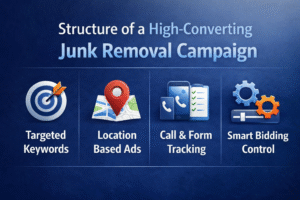
Campaign settings are often another source of problems. Many accounts have auto-apply recommendations turned on, broad keywords across multiple ad groups, and little to no negative keyword strategy. Some campaigns are also pushed into full automation too early, before the structure and tracking are properly set up.
This usually leads to higher costs, lower-quality leads, and unpredictable results because the system is trying to optimize based on incomplete or inaccurate signals.
In contrast, high-performing junk removal campaigns are usually very simple and structured around clear intent. They focus on high-intent keywords such as:
junk removal near me
furniture removal service
same day junk removal
appliance removal near me
The ads clearly mention the service area, the type of work offered, and the main value proposition. Conversion tracking is set up properly for both phone calls and form submissions. Automation is introduced gradually, only after the campaign has clean data and a solid structure.
When these fundamentals are in place, performance tends to become more stable. Lead flow becomes more predictable, and cost per lead is easier to control.
Most underperforming junk removal campaigns are not failing because of the market or competition. They are failing because of broad keywords, generic messaging, inaccurate tracking, and messy account structure. Once those areas are corrected, results often improve significantly.
For junk removal businesses experiencing inconsistent Google Ads performance, a simple account audit is often enough to identify the main issues. In many cases, a few structural adjustments can lead to a noticeable improvement in both lead quality and cost efficiency.